


Family Crests Store
Scott Family Crest mug
Scott Family Crest mug
Couldn't load pickup availability
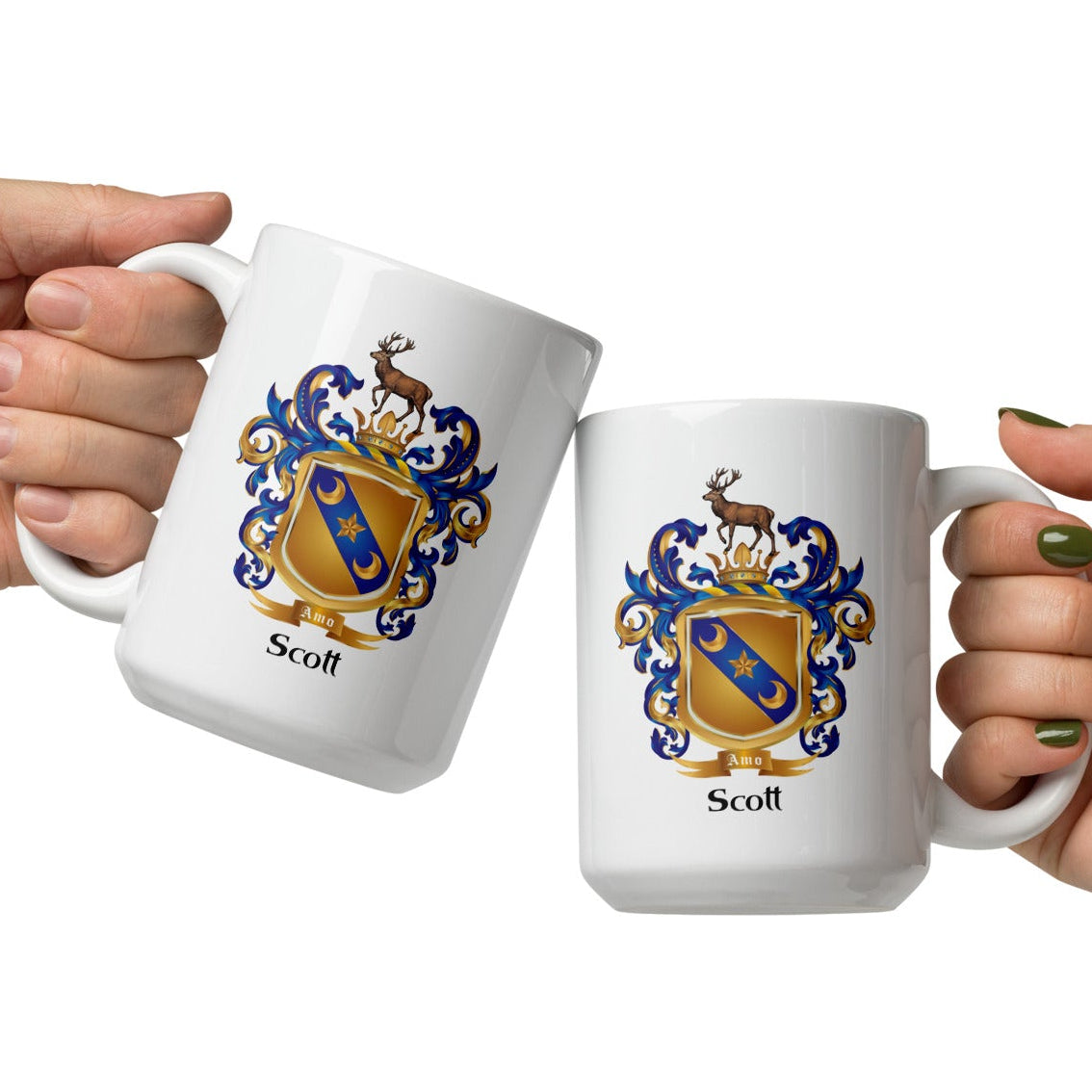
The Scott Family Crest on a classic white mug. Beautifully illustrated. Carefully researched. Uniquely personal.
Eminently suited for a proper brew! Whether it's a gift to mark a milestone birthday, a new home, or Christmas morning — here's an artwork with history in your hands.
The origin of the name Scott
The Latin Etymology: The surname Scott derives from the Late Latin word Scotus, a term originally applied by the Romans to identify Gaelic-speaking raiders from Ireland who later established settlements in western Scotland.
Geographical Identification: Over time, the term evolved into a geographical and ethnic identifier for a native of Scotland. In the English border counties, the name was specifically used to denote a person originating from north of the border.
The Earliest Documented Ancestor: The first recorded use of the name as a hereditary surname appears in 1116, when Uchtredus filius Scotti (Uchtred, son of a Scot) signed his name as a witness to a historic land charter issued by King David I of Scotland.
The symbolism of the Scott coat of arms
This version of the crest is officially recorded in Volume One of the Public Register of All Arms and Bearings in Scotland, which was established in 1672 at the Court of the Lord Lyon in Edinburgh. In these official records, the design is registered as a stag trippant Proper, attired and unguled Or (a natural-colored walking stag with golden antlers and hooves) atop a shield of Or, on a bend Azure, a star between two crescents of the field (a golden shield divided by a blue diagonal band). The historical prominence and success of the Scotts of Buccleuch established their house as the chief lineage of the name, naturally connecting these traditional heraldic emblems to the broader heritage of individuals bearing the Scott surname worldwide.
Exploring the individual elements of this coat of arms reveals the specific virtues and values that each symbol traditionally represents.
The Gold Field (Or): In traditional heraldry, the gold color of the shield symbolizes generosity, elevation of mind, and stainless honor.
The Blue Bend (Azure): The diagonal blue band running across the shield represents truth, strength, and unswerving loyalty to a cause or monarch.
The Star and Crescents: These celestial charges are classic identifiers in Scottish Border heraldry. The five-pointed star signifies honor and divine guidance, while the twin crescent moons symbolize hope, enlightenment, and future glory.
The Stag Trippant: The walking stag represents peace, harmony, and political wisdom, while paying homage to the ancient forests of the Scottish Borders.
The Motto Amo: this Latin word translates directly to "I love," serving as a peaceful counterweight to the family's historic martial reputation.

Image: Map of Ewesdale and Eskdale featuring the Scott arms (1654) by Joan Blaeu & Timothy Pont. Source: Dukes and Princes / Public Domain.
Significant figures historically associated with the clan
Sir Walter Scott of Buccleuch (“The Bold Buccleuch”): A renowned 16th-century Border chieftain and military leader. In 1596, he launched a daring night assault on the English-controlled Carlisle Castle to rescue his imprisoned kinsman, Kinmont Willie Armstrong, an exploit that became a defining moment in Border history.
Walter Scott of Harden (“Auld Wat”): An influential 16th-century reiver chieftain who operated out of the standard fastnesses of the Scottish Marches. He led major tactical cattle raids across the English border to secure wealth and land for his branch of the family.
Anne Scott, 4th Countess of Buccleuch (1651–1732): One of the wealthiest peeresses in British history. She married the Duke of Monmouth (the eldest illegitimate son of King Charles II) in 1663, and they were jointly created the Duke and Duchess of Buccleuch, cementing the family's position at the pinnacle of the aristocracy.
Sir Walter Scott (1771–1832): The globally celebrated novelist, poet, and historian. A direct descendant of the Scotts of Harden, he authored monumental works such as Waverley, Rob Roy, and Ivanhoe, single-handedly reviving international interest in Scottish clan culture and heritage during the 19th century.
Legendary medieval tales connected to the Scott name
The Naming of Buccleuch
Clan tradition dictates that during an early medieval royal hunting expedition in the Ettrick Forest, a large buck became trapped in a deep, precipitous ravine (known in the local Scots dialect as a “cleuch”). The cornered animal turned fiercely on the royal hunting party, putting the monarch in direct danger. A young man from Galloway, ancestor to the clan chiefs, rushed into the ravine, seized the charging buck by its antlers, wrestled it to the ground, and carried it out on his shoulders. In gratitude for saving his life, the King named the man the royal Ranger of the forest and bestowed upon him the estate of “Buck-cleuch” (Buccleuch), establishing the name of the primary Scott lineage.
The Feast of the Spurs
A well-documented historical anecdote highlights the rugged reality of life in the Scottish Borders under the chieftainship of “Auld Wat” of Harden. Upon returning to his stronghold after a period of peace, his followers gathered in the banquet hall for dinner, only to find the castle stores entirely depleted of meat. His wife, Mary Scott—famously known as the “Flower of Yarrow”—placed a covered silver platter before her husband. When the lid was lifted, the dish contained no food, but instead held a single pair of clean steel spurs. This silent, traditional gesture signaled to the clan that if they wished to eat, they needed to mount their horses immediately and ride south to raid the English borders for cattle.
Product details
- High quality white ceramic mug with the family crest printed two sides
- Dishwasher and microwave safe
- 15 oz mug dimensions: 4.7″ (11.9 cm) in height, 3.3″ (8.5 cm) in diameter
No Warehouses. No Waste. Just for you, made to order
This product is printed especially for you when ordered, one at a time, by royal decree of Mother Nature to keep the realm beautiful. Family Crests Store guarantees your custom treasure meets all EU and USA safety standards.
About the artist
Each coat of arms in the Family Crests Store is an artwork by heraldic artist Éamonn Breathnach. All are carefully researched, drawing from the earliest available records across multiple heraldic archives. Noted for their elegance and attention to detail, these artworks make meaningful gifts for family occasions.
Don't see your family name?
I'm always happy to add new crests and products to the collection, so please get in touch if you can't find what you're looking for. ⚜️


🎁 Complete the Scott Family Collection
Explore matching Scott family crest gifts.
🛡️ Search Another Family Name
Searching for family, a colleague, or a corporate client? A family crest makes a thoughtful alternative to generic gifts.
