

Family Crests Store
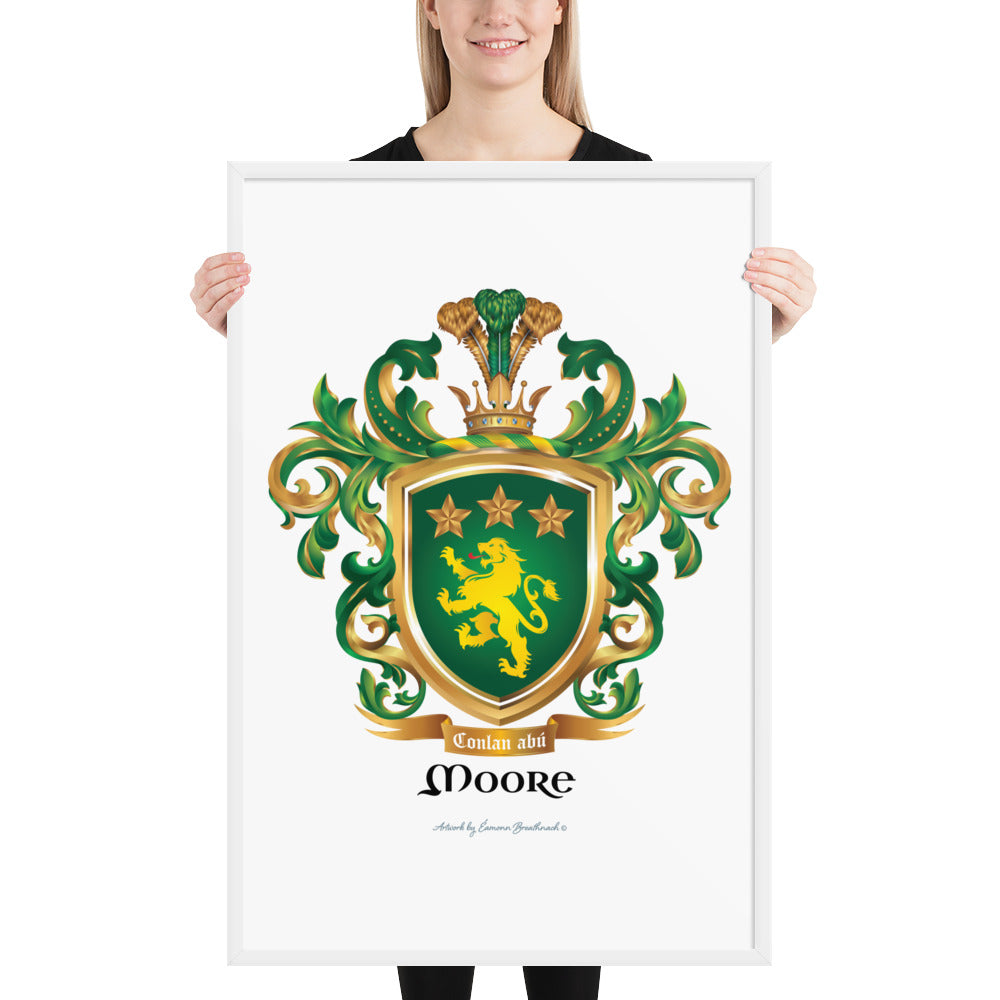
Moore Family Crest framed artprint
Moore Family Crest framed artprint
Couldn't load pickup availability
The Moore Family Crest framed and printed on museum-quality matte paper. Beautifully illustrated. Carefully researched. Uniquely personal.
A meaningful gift for family occasions—whether it’s a milestone birthday, a Father’s Day surprise, a housewarming or a wedding, this piece is an instant heirloom.
The origin of the name Moore
The surname Moore serves is an anglicised form of the ancient Irish Gaelic name Ó Mórdha, which translates to "descendant of Mórdha." The personal name Mórdha is derived from the Old Irish word meaning "great," "proud," "majestic," or "noble." Historically, this clan did not emerge from an occupation or a geographical feature, but rather as the primary sovereign dynasty of the "Seven Septs of Leix" (modern County Laois). From the early medieval era through the late sixteenth century, the family held immense political and territorial power in the province of Leinster, successfully defending their borders against both neighboring clans and Anglo-Norman expansion.
The symbolism of the Moore coat of arms
Traditional Irish genealogical manuscripts, including historical tracts on the tribal lineages of Leinster, trace the O’More ancestry back to Conall Cernach, the celebrated chief warrior of the Red Branch Knights of Ulster. In early Celtic tradition, sovereign warrior families frequently used predatory animals as military emblems. When native Gaelic lines eventually formalised their insignia under the Ulster Office of Arms (established in 1552) to match European conventions, the gold lion rampant was recorded to officially denote this ancient, independent warrior status and to firmly establish their pre-Norman royal bloodlines. The Moore coat of arms is also described in the 1884 edition of Burke’s General Armory.
The Shield Color: The vibrant green field (vert) is an established heraldic symbol denoting hope, joy, and loyalty. Within Gaelic history, it signifies the clan's deep, ancestral connection to their sovereign territories along the midlands of Ireland.
The Standing Lion: The gold lion rampant standing on its hind legs is a classic symbol of majestic leadership, deathless courage, and military strength. In the medieval and Celtic eras, the lion was specifically reserved for sovereign chieftains and royal bloodlines to denote supreme authority.
The Three Stars: Positioned in the upper section of the shield, the three gold five-pointed stars (referred to heraldically as mullets) signify honor, chivalry, and celestial guidance. In early medieval warfare, stars on a shield were used to denote steadfast virtue and protection.
The Motto: Located on the scroll below the shield, the phrase Conlan abú features the traditional Gaelic war cry abú, meaning "forever" or "to victory." Conlan references the clan's historic tribal ancestry linking back to the legendary Conall Cernach mentioned above.
Notable historical figures
Ruairí Óg Ó Mórdha (died 1578): A celebrated Gaelic chieftain and warrior who led the local resistance forces against the Tudor conquest of Ireland during the mid-sixteenth century, fighting continuously to preserve the autonomy of his clan’s ancestral homeland.
Marguerite Moore (1846–1933): Born in Waterford, Marguerite Moore was a prominent Irish nationalist, orator, and social activist. In 1881, she became a foundational leader within the Ladies' Land League, an organization formed to prevent the eviction of tenant farmers and provide relief to families displaced during the Irish Land War.
Annie Moore (1874–1924): Originally from County Cork, Annie Moore is a historic figure of the Irish diaspora, recognized globally as the very first immigrant processed through the Ellis Island federal immigration station in New York Harbor when it opened on January 1, 1892. At just 17 years old, she made the transatlantic journey aboard the steamship Nevada alongside her two younger brothers to reunite with their parents. Today, she serves as a universal symbol of the millions of Irish emigrants who departed during the 19th and 20th centuries. She is permanently honored with two identical bronze statues sculpted by Jeanne Rynhart—one located at her port of departure in Cobh, Ireland, and the other at her port of arrival on Ellis Island.
About the artist
Each coat of arms in the Family Crests Store is an artwork by heraldic artist Éamonn Breathnach. All are carefully researched, drawing from the earliest available records across multiple heraldic archives. Noted for their elegance and attention to detail, these artworks make meaningful gifts for family occasions.
Product details
• Printed with water-based inks.
• Ayous wood .75″ (1.9 cm) thick frame sourced from renewable forests
• Paper thickness: 10.3 mil (0.26 mm)
• Paper weight: 189 g/m²
• Acrylite front protector for durability and clarity
• Hanging hardware included for easy display
No Warehouses. No Waste. Just for you, made to order.
This product is printed especially for you when ordered, one at a time, by royal decree of Mother Nature to keep the realm beautiful. Family Crests Store guarantees your custom treasure meets all EU and USA safety standards.
Don't see your family name?
If you'd like a name added to the collection, please get in touch.
Share