

Family Crests Store
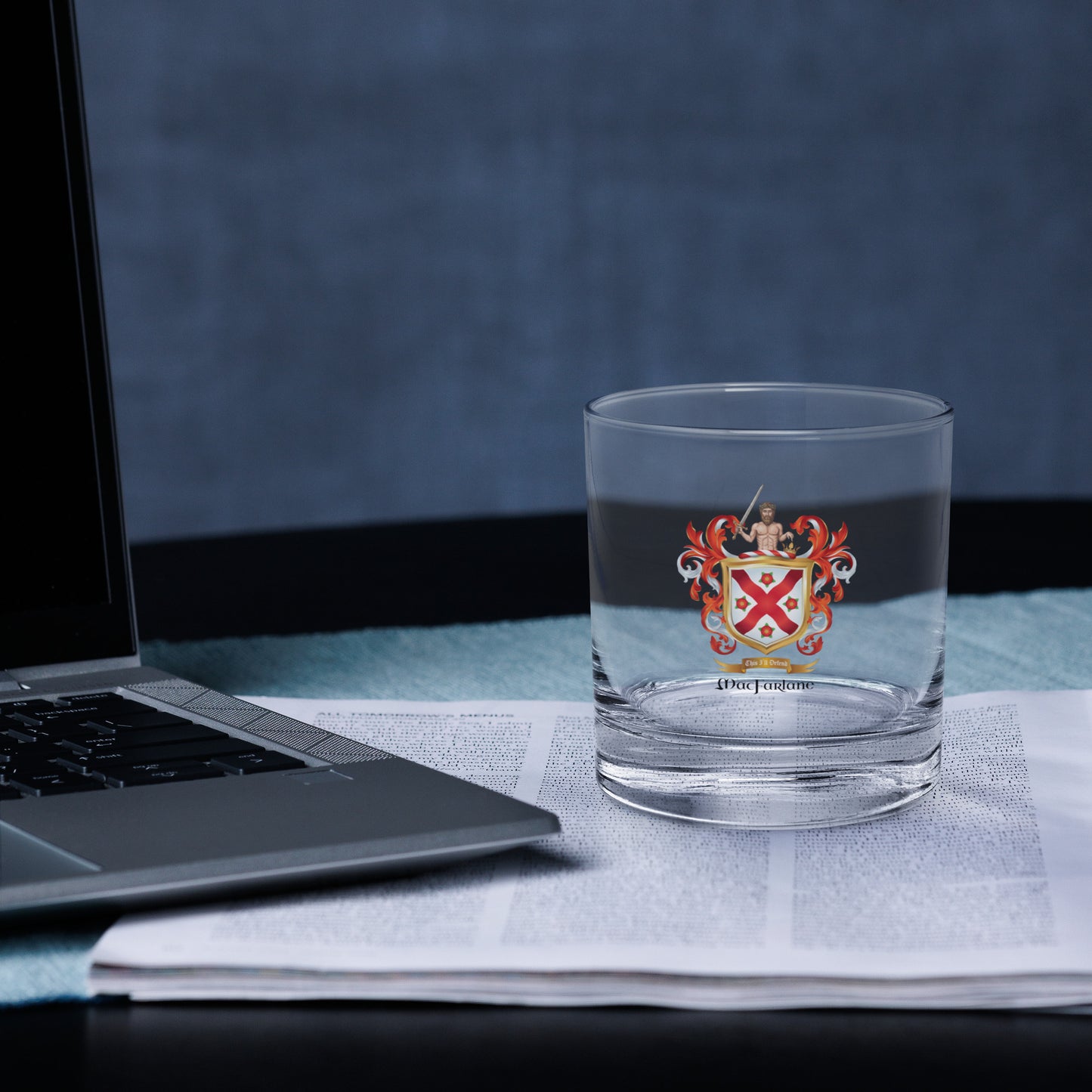
MacFarlane Family Crest Rocks Glass - Uppercase F
MacFarlane Family Crest Rocks Glass - Uppercase F
Couldn't load pickup availability
Here’s a proper gift for any MacFarlane who enjoys a wee dram of whisky. The MacFarlane Family Crest on a classic rocks glass. Beautifully illustrated. Carefully researched. Uniquely personal.
Nicely suited for the moments that call for a proper toast. Whether it’s a milestone birthday, a Father’s Day surprise, a new home or a wedding gift, this piece is an instant heirloom.
The origin of the name MacFarlane
The surname Macfarlane is a patronymic name of Scottish Gaelic origin, derived from Mac Pharlain, which translates to "son of Parlan" (the Gaelic variation of the name Bartholomew). The clan traces its lineage directly to the ancient Celtic Earls of Lennox. In the thirteenth century, Gilchrist, a younger brother of Malduin, 3rd Earl of Lennox, was granted a land charter for Arrochar on the shores of Loch Long. Gilchrist’s great-grandson was named Parlan, and it is from this individual that the family adopted their hereditary surname. During the fourteenth century, Parlan's son Malcolm MacFarlane received a formal charter confirming the family's continuous possession of the Arrochar lands, establishing the independent chiefly line of the clan.
Military Migrations (The Redshanks): Prior to formal colonization, during the sixteenth century, members of Clan MacFarlane traveled from the western Highlands to Ireland as "Redshanks"—Scottish mercenary soldiers hired by native Irish chieftains (such as the O'Neills and O'Donnells) to fight against Tudor expansion in Ulster.
The Plantation of Ulster (17th Century): The most significant permanent migration occurred during the official Plantation of Ulster under King James VI and I. The feudal superior of the MacFarlanes, the Earl of Lennox, was granted a 3,000-acre landholding in Northern Ireland. A substantial number of MacFarlane clansmen accompanied him and settled permanently in the province.
The symbolism of the MacFarlane coat of arms
In official registries, including the records of the Court of the Lord Lyon and the 1884 edition of Burke’s General Armory, the baseline coat of arms for the head of the clan (MacFarlane of that Ilk) is recorded under the official description argent (meaning a silver/white shield), a saltire engrailed cantoned with four roses gules...the following will help untangle this medieval discription:
The Shield Color: The silver or white background traditionally signifies purity and sincerity.
The Engrailed Saltire: The large diagonal cross represents the cross of St. Andrew, the patron saint of Scotland. To differentiate their lineage from the smooth-edged cross of their ancestral kinsmen, the Earls of Lennox, the MacFarlane line utilized an "engrailed" edge, consisting of uniform scalloped curves. The cross is colored red (gules), the heraldic symbol for military fortitude.
The Four Roses: Positioned in the quarters surrounding the cross, the four red roses are directly derived from the original armorial shield of the Earls of Lennox, serving as a formal marker of the family's historic descent.
The Crest: Positioned above the shield, the crest depicts a half-length figure of a wild man (demi-savage) waving a broadsword in his right hand and pointing with his left hand to an Imperial Crown.
The motto: This specific crest, paired with the motto This I'll Defend, was formally recognized following the Battle of Langside in 1568, where the clan fought to secure the crown of the infant King James VI.
Notable historical figures
Malcolm MacFarlane (14th Century): The son of Parlan who was the first to formally adopt the patronymic surname in legal land transactions, solidifying the clan's independent status within the Lennox district.
Andrew MacFarlane (11th Chief, c. 1544–1612): The clan chieftain who commanded the MacFarlane forces at the Battle of Langside on May 13, 1568. His military intervention was a major factor in the battle, directly resulting in the crown's formal recognition of the clan's defensive crest and motto.
Helen Macfarlane (1818–1860):A Scottish philosopher, Chartist journalist, and early feminist writer. Writing under the pseudonym Howard Morton, she became the first person to translate Karl Marx and Friedrich Engels' Communist Manifesto from German into English, published in London in 1850. Marx considered her 'a rare and original thinker' within the British reform movement.
About the artist
Each coat of arms in the Family Crests Store is an artwork by heraldic artist Éamonn Breathnach. All are carefully researched, drawing from the earliest available records across multiple heraldic archives. Noted for their elegance and attention to detail, these artworks make meaningful and uniquely personal gifts for any occasion with family and friends.
Product details:
- Glass material
- Volume: 10.5 oz. (311 ml)
- Height: 3.4″ (8.64 cm)
- Diameter: 3.2″ (8.13 cm)
- Please hand-wash only. Not recommended for dishwasher or microwave use.
No Warehouses. No Waste. Just for you, made to order.
This product is printed especially for you when ordered, one at a time, by royal decree of Mother Nature to keep the realm beautiful. Family Crests Store guarantees your custom treasure meets all EU and USA safety standards.
Don't see your family name?
If you'd like a name added to the collection, please get in touch.
Share