

Family Crests Store
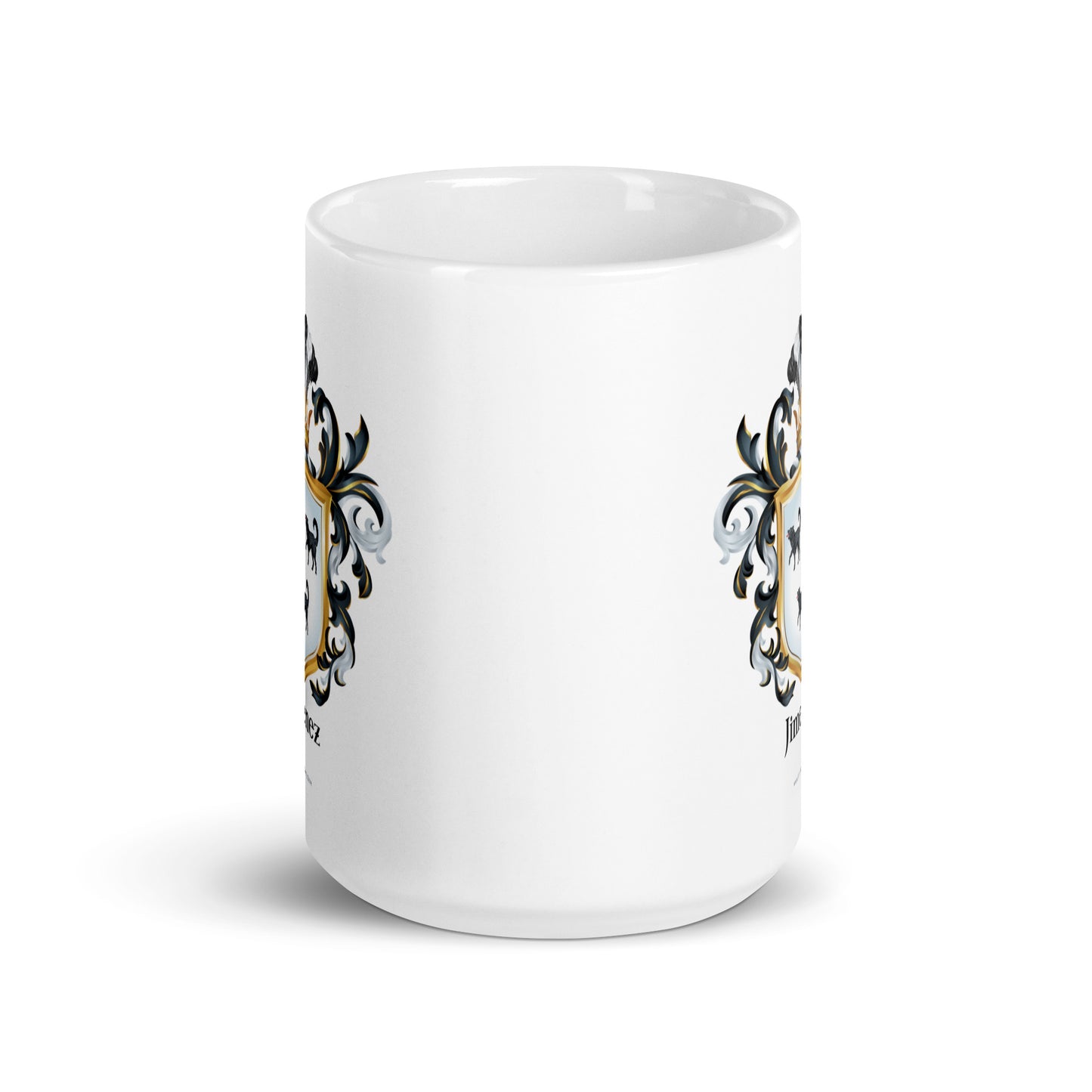
Jimenez Family Crest mug - Aragon origin
Jimenez Family Crest mug - Aragon origin
Couldn't load pickup availability
A Jimenez Family Crest mug is a meaningful choice as a Father’s Day gift and it's also guaranteed to get a happy reaction as a Christmas or birthday present. It’s nice to have in the home as a conversation starter to get the kids talking about family and heritage. Beautifully illustrated. Carefully researched. Uniquely personal.
The symbolism of the Jimenez family crest
This historic coat of arms features a clean white shield displaying three black wolves—which in older, medieval illustrations are occasionally drawn resembling large mastiffs or hounds—positioned vertically in a walking stance with their tongues shown in sharp red. In traditional Spanish family emblems, the solid white background signifies peace, purity, and sincerity, while the bold black color of the animals denotes constancy, protection, and a fierce resistance to adversaries. The wolf carries an incredibly powerful and ancient backstory in the heraldry of northern Spain and the Basque territories. Rather than being viewed simply as a predator, the wolf was deeply revered by early Iberian knights as a symbol of an elite warrior, representing unmatched cunning, strategic intelligence on the battlefield, and a fierce, unyielding loyalty to the clan. Arranging three wolves vertically was a traditional method used by royal heralds to show a lineage of multiple generations of leaders who successfully guarded their ancestral lands. The entire display is completed with stylized flowing mantling surrounding the polished steel helmet, mimicking the protective battle cloaks worn by high-ranking medieval commanders.
This exact three-wolf layout stands as the absolute oldest, primitive design recorded for the family line. It was first officially documented in the early medieval armorial registries of the Kingdom of Aragon, where royal chroniclers recorded it as the ancient ancestral right belonging to the noble hijos-dalgo—the traditional gentry and knights—of the foundational Jiménez mountain estate located in the rugged peaks of Jaca. These records were later formalized and permanently secured in the master state registries of Spanish nobility, including the definitive multi-volume reference work Nobiliario de los Reinos y Señoríos de España, ensuring this fierce warrior heritage was locked into official history books for all future generations.
The origin story of the Jimenez name
The surname Jimenez is patronymic in origin, meaning it originally developed during the early Middle Ages to identify an individual simply as the son of Jimeno or Ximeno. The name itself stems from an ancient pre-Roman Iberian and Basque root word, Semeno, which translates historically to ancient titles meaning son or little son. Because patronymic names developed independently across different mountain valleys as the Christian kingdoms of northern Spain began to expand, multiple distinct branches of the name arose during the early medieval period. From their ancestral cradles in the mountains of Jaca and Navarre, enterprising descendants of this noble house migrated westward and southward, registering new branches of the lineage in Valencia, La Rioja, and Castile as they participated in the administrative and military stabilization of the peninsula.
Over the centuries, several notable historical figures have carried this surname to immense global prestige. Cardinal Francisco Jiménez de Cisneros, who lived from 1436 to 1517, was one of the most formidable political and religious statesmen in European history, serving as the Archbishop of Toledo, the Grand Inquisitor, and the twice-appointed Regent of Spain who governed the global empire following the death of King Ferdinand. Later, in the 16th century, Gonzalo Jiménez de Quesada became a celebrated Spanish lawyer, explorer, and conquistador who led a grueling expedition into the northern Andes, successfully founding the capital city of Bogotá and establishing the Kingdom of New Granada in modern-day Colombia. In the modern era, the name achieved ultimate cultural renown through Juan Ramón Jiménez, the brilliant Spanish writer and poet who was awarded the Nobel Prize in Literature in 1956 for his masterly lyrical poetry and his classic narrative work Platero y yo.
About the artist
Each crest featured on this site is an illustration created by heraldic artist Éamonn Breathnach. Éamonn’s artworks are the result of careful research, drawing on the earliest records available from various heraldic archives. Noted for their elegance and attention to detail, these artworks make meaningful and uniquely personal gifts for any occasion with family and friend.
Product details
- High quality white ceramic mug
- Dishwasher and microwave safe
- 15 oz mug dimensions: 4.7″ (11.9 cm) in height, 3.3″ (8.5 cm) in diameter
- Lead and BPA-free material (complies with US and EU safety standards)
No Warehouses. No Waste. Just for you, made to order.
This product is printed especially for you when ordered, one at a time, by royal decree of Mother Nature to keep the realm beautiful. Producing items on demand rather than in bulk helps minimize overproduction and environmental impact.
Don’t see your family name?
I’m always happy to add new crests to the collection, so please get in touch. ⚜️
Share