Skip to product information
1 of 4

Family Crests Store

Black Family Crest beer glass

Black Family Crest beer glass

Regular price £22.00 GBP
Regular price Sale price £22.00 GBP
Sale Sold out
⭐ Free shipping on mugs and glassware. ⭐

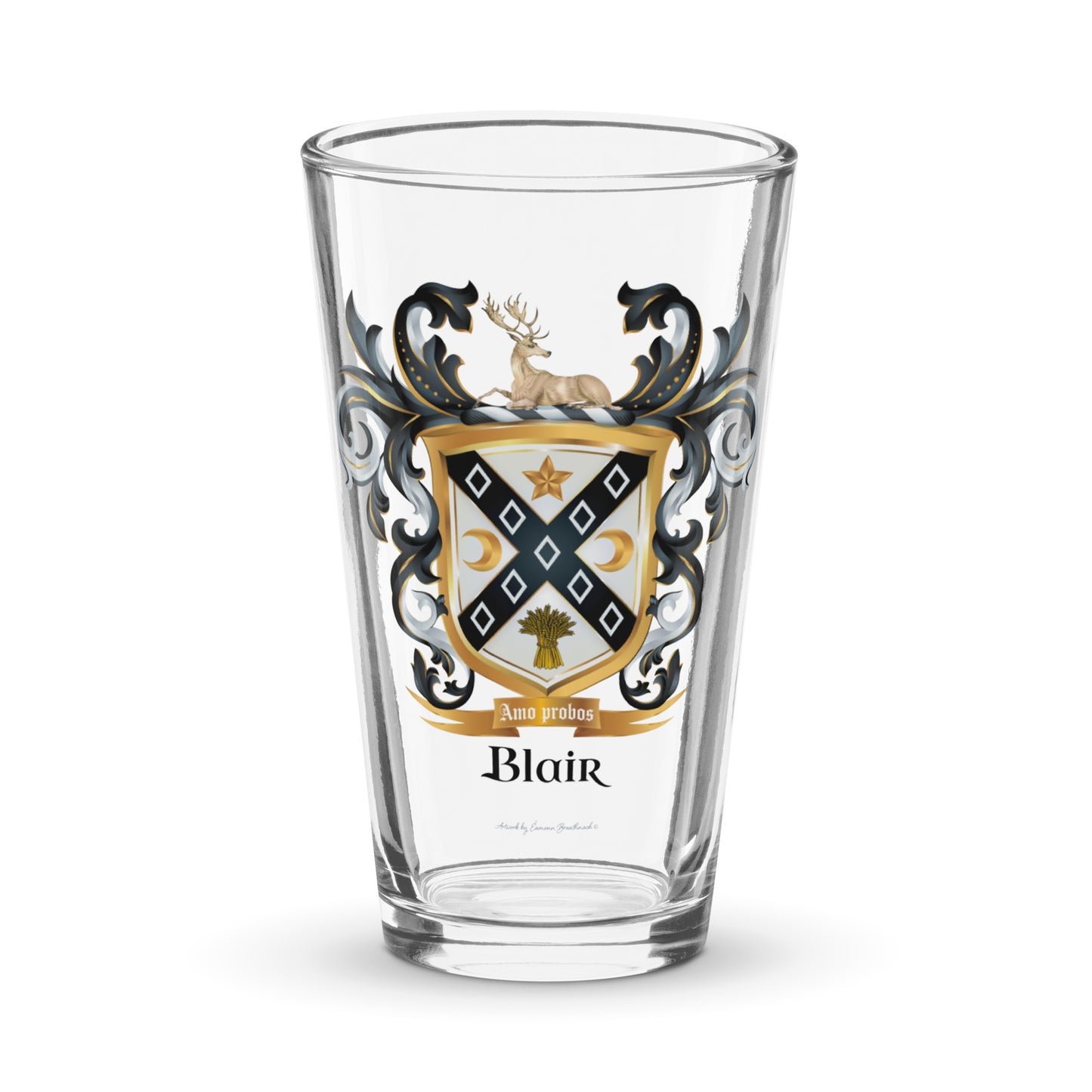
Here’s a proper gift for anyone called Black who enjoys a beer! The Black Family Crest on a sturdy 16oz pint glass. Beautifully illustrated. Carefully researched. Uniquely personal.

The symbolism of the Black family crest

The white background on the Black family coat of arms shield traditionally represents peace, sincerity, and innocence. Spanning the center of the shield is a prominent black chevron, an inverted V-shaped architectural symbol that mimics the rafters of a roof or a fortress. Historically, the chevron signifies protection, safety, and faithful service, often awarded to those who successfully defended a position or built a significant structure.

In the upper section of the shield sit three vibrant red five-pointed stars. In ancient heraldry, these stars were referred to as mullets. An intriguing historical anecdote noted by early heraldic writers like Ralph Brooke indicates that the term "mullet" actually derives from the Old French word molette, meaning the rowel of a knight's spur. Rather than representing a celestial body, these stars were often granted to commemorate a knight who had "won his spurs" through acts of outstanding valor or chivalry under the cover of night.

Directly below the chevron, in the lower portion of the shield, rests a red crescent moon with its horns pointing upward. The crescent moon is traditionally a symbol of high honor, hope, and enlightenment. In lineage registries, it was also frequently used as a mark of cadency to denote a second son, signifying that the bearer would ascend to bring new light and glory to the family name.

Crowning the entire display above the shield is the crest itself: a fierce gold lion standing on its hind legs with its forepaws raised in mid-strike, emerging from a gold crown. This posture represents undisputed courage, majesty, and strength. Finally, the golden scroll beneath the shield features the family’s historic Latin motto: Spes lucis aeternae, which translates faithfully to "Hope of eternal light." This motto directly complements the guiding presence of the stars and the crescent moon on the shield.

The origin of the surname Black

The surname Black is rooted in ancient European nomenclature, developing primarily as a descriptive nickname or an occupational identifier. Etymological and historical records from The College of Arms and early census rolls indicate that the surname primarily derived from the Old English words blæc or blaca, which translated to "black" or "dark-complexioned." It was originally applied by Anglo-Saxon or Celtic communities to distinguish individuals with particularly dark hair, deep eye color, or a swarthy complexion.

In Scotland and Ireland, the name frequently developed as an Anglicized rendering of the Scottish Gaelic word Dubh, meaning dark or black, often filtering into formal records through clan alliances such as Clan Lamont, Clan MacLean, and Clan MacGregor.

A pivotal chapter in the history of this specific coat of arms occurred during the 17th-century Plantation of Ulster. Massive migrations of Scottish and English families moved across the Irish Sea, establishing a prominent Scots-Irish and Ulster-Scots lineage. Distinct, influential branches of the Black family firmly rooted themselves in the northern Irish counties of Antrim, Down, and Donegal. These families maintained their historic heraldic traditions, and this specific armorial design—with its silver field, black chevron, and red stars—became officially recognized in regional Irish genealogical rolls, bridging the family's history between Scotland and Ireland.

The earliest officially recorded use of the surname appears in the Old English Bynames Register, which documents an individual named Wulfhun des Blaca in the year 901 AD. As formal record-keeping advanced into the medieval period, the name appears consistently across the British Isles. In early Latin charters from Scotland, the name was translated directly into its Latin equivalent, Migro or Niger; historical records from the Court of the Lord Lyon note that a Hugh Niger witnessed a prominent land charter in the region of Angus in 1178 AD. In England’s Hundred Rolls of 1273 AD—an extensive census compiled during the reign of King Edward I—the name is recorded in its transitional Middle English form with the listing of Hamo le Blake.

Notable historical figures

Throughout history, several prominent individuals have borne the Black surname, distinguishing themselves in the fields of science, commerce, and civic leadership:

Dr. Joseph Black (1728–1799): One of the most historically significant figures associated with this surname, Dr. Black was an eminent physician and chemist. He was born to a prominent Belfast merchant family whose deep ancestral roots and commerce networks were established in County Down and Belfast. This Ulster-Scots merchant dynasty is directly linked to the northern Irish armorial records of this specific coat of arms. Dr. Black made groundbreaking scientific discoveries, including the identification of carbon dioxide (which he termed 'fixed air'), latent heat, and specific heat, laying the foundation for modern chemistry.

John Black of Aberdeen (1500s): Recorded extensively in early Scottish civic and burgess rolls, John Black established a prominent line of merchants and magistrates within the city of Aberdeen. For over four centuries, his direct descendants served as Burgesses of Aberdeen, firmly cementing the Black name as a cornerstone of regional civic governance, trade, and legal administration under the oversight of the Court of the Lord Lyon. Elements of this prominent merchant lineage later intermarried and connected with the Ulster merchant families of northern Ireland.

William Black (1841–1898): A highly celebrated 19th-century novelist and journalist born in Glasgow, Scotland. He achieved immense international literary acclaim during the Victorian era for his vivid depictions of Scottish life, landscapes, and culture. His prominent standing in society brought further cultural distinction and global recognition to the historic family name.

About the artist

Each crest featured on this site is an artwork by heraldic artist Éamonn Breathnach. Éamonn’s designs are carefully researched, drawing on the earliest available records from a broad range of heraldic archives. Noted for their elegance and attention to detail, these artworks make meaningful and uniquely personal gifts for any occasion, with family and friends.


Product details:
• Glass material
• Volume: 16 oz (473 ml)
• Not dishwasher or microwave recommended – hand wash only.
• Simple yet durable design
• Suitable for use as a mixing glass

Size guide

WIDTH (inches) LENGTH (inches)
16 oz 3 ½ 5 ⅞

No Warehouses. No Waste. Just for you, made to order.

This product is printed especially for you when ordered, one at a time, by royal decree of Mother Nature to keep the realm beautiful. Family Crests Store guarantees your custom treasure meets all EU and USA safety standards.

Don't see your family name?

If you'd like a name added to the collection, please get in touch.

View full details